One Fixable Barrier Sits Under All of It
Readiness, obsolescence, sole sourcing, and no-bids look like four problems. On the hardest parts they are mostly one: technical data that is not ready to support a buy. Where the data is ready, industry answers.
No-Bids Per Month
Up from 500 per month in 2020
Solicitations, No Award
Public-data sample of 4,774 NSNs
Parts, Two or Fewer Suppliers
1,318 rate high or critical obsolescence
Fleet Mission Capable
FY2024 Air Force rate — lowest in a decade
No-bids more than doubled
500 per month in 2020 to 1,200 per month in 2024, and grown since, by the wing's own reporting. A public-data sample of 4,774 NSNs shows the same pattern from the outside: 28.8% of solicitations end with no award.
Technical data locks out suppliers
AMSC G is the only code supporting full and open competition. Every other assignment means rights, data, tooling, or qualification stands between the requirement and a competed award.
The supply base is thin and aging
2,267 parts have two or fewer current suppliers. 1,318 rate high or critical obsolescence risk. The machine-shop base shrank 4.3% since 2021 — capacity is leaving the market faster than it is being replaced.
The demand is already committed
$2.61B in forecast requirements through 2030 on the sampled parts, covering 113 million units. The requirement is queued regardless. The only open question is whether supply can answer it.
Public-data sample: 4,774 NSNs • solicitation and award history 2021 to present • a small slice of what the wing manages every day
Downstream Effect
Readiness Is the Symptom
Air Force fleet-wide mission capable rate fell to 67.15% in FY2024, down from 69.92% in FY2023 and 71.24% in FY2022. Parts availability is not the only driver, but it is the one a technical data fix reaches directly.
40%
F-22 Raptor
Mission Capable
51%
F-35A Lightning II
Mission Capable
30%
CV-22 Osprey
Mission Capable
42%
B-52 Stratofortress
Mission Capable
FY2024 mission capable rates • Air & Space Forces Magazine
What Changes
Same Authority, Different Evidence
Nothing in this model moves an engineering decision away from the engineering authority. It changes what is on the desk when that decision gets made, and how long assembling it took.
Today
A part fails to attract a bid, and nobody knows until the solicitation closes.
With MILHUB
Forecast agents flag the part on demand history, solicitation outcomes, and DMSMS signals before the buy fails.
Today
Package completeness is unknown until a contractor tries to build from it and starts sending questions.
With MILHUB
Readiness is scored against MIL-STD-31000C up front, with a named gap list routed to whoever can close each gap.
Today
Reverse engineering succeeds, but the resulting data leaves with the contractor.
With MILHUB
New data stays Government-owned. The Air Force keeps its own technical baseline for the usable life of the asset.
Today
Engineering answers the same questions repeatedly across disconnected organizations.
With MILHUB
Agents draft and flag against the standard; engineers disposition and sign within their delegated portfolios.
Policy Alignment
Executing Priorities Already on the Books
Rebuilding the industrial base, breaking vendor lock, and growing nontraditional suppliers are stated departmental priorities. MILHUB is not a competing initiative — it is those priorities applied to one wing's hardest parts at one site.
Vendor lock is named policy, not a talking point
The Department of War's acquisition transformation strategy identifies vendor lock as a barrier, calls for procuring technical data packages that support organic or third-party maintenance, and sets a standard of carrying at least two qualified sources on critical components. TDP readiness scoring is the measurable form of that goal — a second source is not possible for a part whose data cannot support a solicitation.
Shared infrastructure is a funded federal model
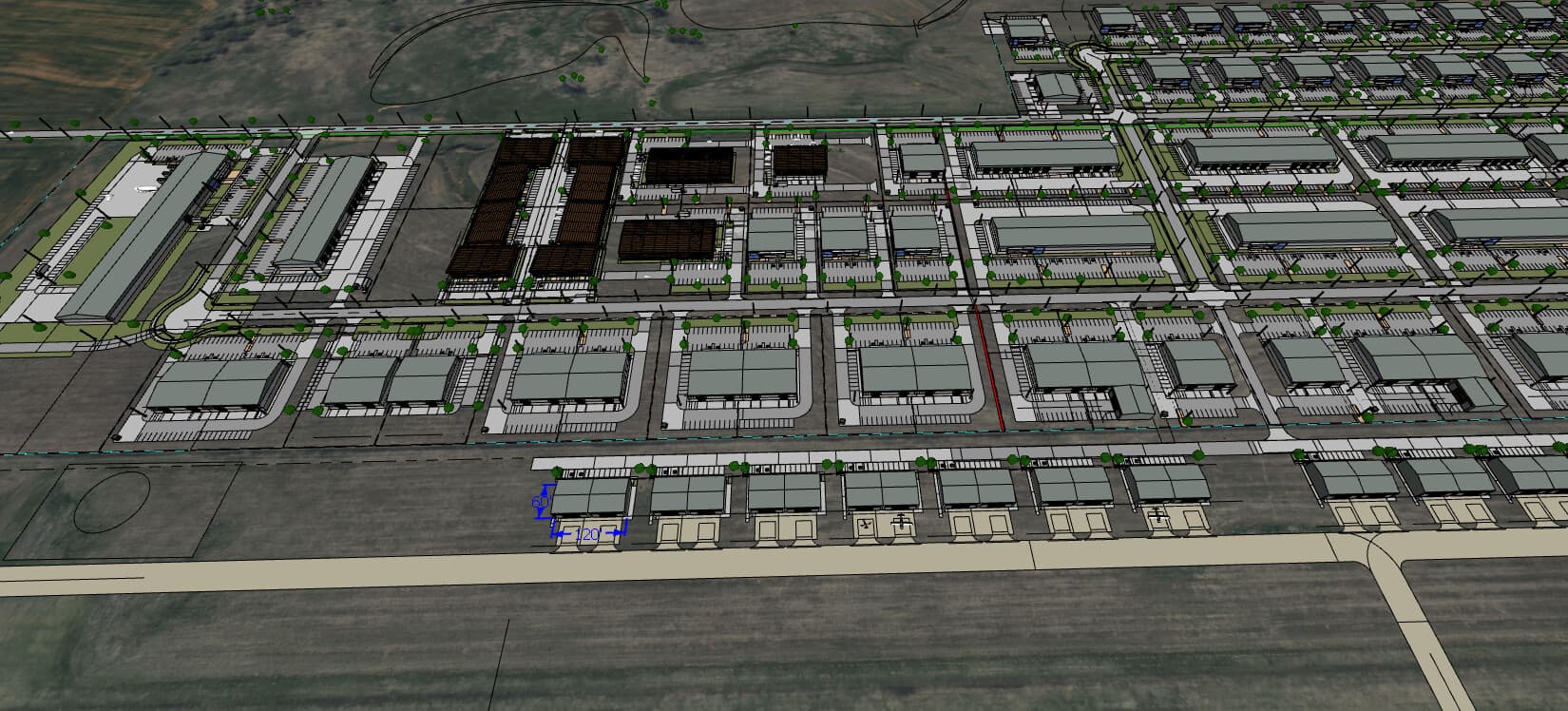
The department's campus programs center on collocating manufacturers of components and subcomponents with access to shared equipment, clustering industrial production capacity in one location to lower the barrier to entry. Chickasha follows that model: repeating spec buildings, a shared qualification and NDE lab, and a reverse-engineering cell no single tenant would fund alone.
Growing nontraditional suppliers
Expanding the industrial base runs through vendor growth and supplier maturity — bringing capable manufacturers that have never held a defense contract into qualification. Hub manufacturers enter recurring supplier-qualification cycles running through 2030, with America Makes accreditation pathways for additive work.
Organic capability comes first
Prototyping is Air Force-led through REACT, REARM, and ALC innovation centers. The hub adds capacity and advanced-manufacturing depth only where a capability gap exists. Nothing in the model asks the Air Force to give up work it can do organically.
The Record
What Oversight Already Found
None of this is a new diagnosis. The gap has been between naming the problem and having a mechanism that closes it part by part.
GAO-25-107468
Data Rights and Vendor Lock
Weapon programs experience vendor lock driven by data rights shortfalls, and existing guidance does not address programs already in sustainment — which is where most of these parts live.
GAO-21-388
Sole-Source Spare Parts
136 sole-source contracts worth $7.9B identified. 57% were commercial items exempt from cost transparency, and contract delays ran as long as 1,154 days.
GAO-24-107378
Sustainment Cost Growth
Sustainment accounts for roughly 70% of weapon system lifecycle cost. The Air Force spent $34.2B on fighter sustainment from 2018 to 2023 while readiness continued to decline.
GAO-25-107283
Industrial Base Fragility
DoD relies on a supplier network of more than 200,000 firms, and the commercial tools used to assess supply chain risk are only 60 to 70 percent accurate.
Start With the Hardest Parts
Work the barrier side-by-side with wing teams: predict the part, complete the data, open the competition. Air Force decisions at every gate, Government-owned data throughout.