For Manufacturers
Move In. Start Building.
Twelve capabilities have to exist within reach of each other before a hard part can actually be built. MILHUB is assembling them on one campus — with the technical data scored in advance and the qualification lab already shared.
Parts, Two or Fewer Suppliers
Open demand with a thin or single source
High or Critical Obsolescence
Parts at risk of losing their source entirely
Demand Queued to 2030
Forecast requirements on the sampled parts
Machine-Shop Base Decline
Contraction since 2021 — capacity leaving the market
Public-data sample: 4,774 NSNs • solicitation and award history 2021 to present
What You Get
The Barriers, Removed Before You Arrive
Most shops capable of building these parts are kept out by three things: not knowing which parts are worth chasing, not being able to build from the data package, and not being able to afford qualification. The hub exists to remove all three.
Demand identified before you arrive
Problem parts are scored and queued by risk, not guessed at. You see which parts have thin sourcing, committed demand, and technical data complete enough to build against.
Technical data that is actually usable
The barrier that kills most defense part work is a package you cannot build from. TDP readiness is scored per part before anything goes to solicitation, so you are not bidding blind on completeness.
Shared qualification infrastructure
NDT, metrology, and test are campus resources. You do not build and certify your own lab to qualify a part — that capital barrier is the one the hub exists to remove.
A supplier-qualification pathway
Hub manufacturers enter recurring supplier-qualification cycles running through 2030, with America Makes accreditation pathways for additive work.
Digital engineering toolchain
Siemens CAD, PLM, and simulation are the campus backbone, so CAD and simulation artifacts attach directly to the part's case file rather than living in a vendor silo.
Logistics already in place
Daily truck runs to Tinker AFB 51 miles away. Union Pacific and Stillwater Central rail interchange. A 5,101 ft runway on the same site.
Capability Catalog
Twelve Capabilities, One Campus
These are the capabilities aircraft parts actually require. Each card shows what it produces, why the domestic base is thin, and the certifications a resident manufacturer needs to hold.
Primary Manufacturing
Forging & Casting
Open die, closed die, and ring rolling forging. Investment and sand casting. Domestic capacity for large complex sand castings has consolidated into a handful of suppliers, making this one of the most concentrated sole-source bottlenecks in structural parts. Lead times routinely exceed a year.
Representative parts
Landing gear struts, engine mounts, structural fittings, turbine disks, bulkheads, wheel halves
Certifications
AS9100, NADCAP (Heat Treat, NDT, Casting), AMS specs, ITAR
Actively recruiting
CNC Machining
5-axis CNC milling, Swiss-type turning, wire and sinker EDM. The backbone of aircraft part production — every forging and casting requires finish machining. The highest-volume capability the hub needs.
Representative parts
Actuator housings, valve bodies, flight control linkages, fittings, manifolds
Certifications
AS9100, ITAR, ISO 9001
Actively recruiting
Additive Manufacturing
Metal (DMLS, SLM, EBM) and polymer (FDM, SLA) processes. The fastest path to reproducing a part whose original tooling no longer exists, and the capability most directly tied to the campus qualification pathway.
Representative parts
Bracket redesigns, legacy part reproduction, prototypes, low-volume complex geometry
Certifications
AS9100, NADCAP (AM), FAA PMA for certified parts
Actively recruiting
Composites & Fiberglass
Carbon fiber and fiberglass layup, autoclave curing, bonding, and repair. Composite structures are increasingly common on modern aircraft, but repair capability is scarce outside the depot.
Representative parts
Radomes, fairings, panel structures, ducts, repair patches, antenna housings
Certifications
AS9100, NADCAP (Composites), OEM repair approvals
Actively recruiting
Secondary Manufacturing
Sheet Metal & Fabrication
Hydroforming, stretch forming, precision bending, and assembly. Aircraft skin and structural sheet metal is one of the highest-volume sustainment needs — every airframe has hundreds of components that wear and corrode.
Representative parts
Skin panels, access doors, ductwork, shrouds, brackets, structural repairs
Certifications
AS9100, ITAR
Actively recruiting
Heat Treatment & Coatings
Vacuum heat treatment, plating, anodizing, passivation, HVOF and plasma spray. Environmental regulation on hexavalent chromium and cadmium is closing plating shops faster than alternatives qualify, and remaining shops carry long backlogs. Nearly every metal part passes through here, which makes it the most common process bottleneck on the whole chain.
Representative parts
Post-forge heat treatment, hardening, anodizing, plating, thermal spray, HVOF, MIL-SPEC paint
Certifications
NADCAP (Heat Treat, Chemical Processing, Coatings), AS9100, AMS2750, EPA permits
Actively recruiting
Electrical & Avionics
Wire harness fabrication, PCB assembly, connector manufacturing, and avionics packaging. Aging aircraft have wiring that degrades on a schedule — harness replacement is constant demand across every fleet.
Representative parts
Wire harnesses, connector assemblies, PCBs, avionics boxes, sensor packages, EMI shielding
Certifications
AS9100, IPC-A-610/620, J-STD, ITAR
Actively recruiting
Hydraulic & Pneumatic
Component manufacturing, overhaul, and test. Flight controls, landing gear, and brakes all depend on hydraulics, and OEMs have been exiting the low-volume military repair market. Design-controlled parts with no alternate source create fleet-grounding risk.
Representative parts
Hydraulic actuators, servo valves, accumulators, pneumatic regulators, hose assemblies
Certifications
AS9100, NADCAP, SAE AS6081 counterfeit prevention, ITAR
Actively recruiting
Specialty & Support
Fasteners, Gears & Bearings
Precision fastener, bearing, and gear manufacturing. Airframes consume large volumes of specialty fasteners, many sole-sourced with long lead times. Local production removes months of wait from an assembly schedule.
Representative parts
Hi-Lok fasteners, precision bearings, gears, bushings, spacers, springs, retainers
Certifications
AS9100, DFARS compliant materials
Rubber & Polymer
Elastomer molding, seal and gasket fabrication, fuel-resistant polymers. Rubber parts are consumables replaced on a schedule, which makes this recurring, predictable volume rather than one-off work.
Representative parts
Custom seals, gaskets, O-rings, vibration dampeners, fuel bladders, window seals, diaphragms
Certifications
AS9100, QPL listed materials
Tool & Die Making
When a part is reverse engineered or redesigned, new tooling is usually required. On-campus tool and die capability means a rebuild does not stall waiting weeks on an outside vendor.
Representative parts
Precision fixtures, jigs, die sets, molds, gages, holding tools
Certifications
AS9100, ISO 9001
NDT & Quality Lab
Every manufactured part passes non-destructive testing before it enters the supply chain. MILHUB operates this as a shared lab so resident manufacturers do not each need their own — the single largest capital barrier for a shop entering defense work.
Representative parts
X-ray and CT, ultrasonic, magnetic particle, dye penetrant, tensile and fatigue testing, metallography
Certifications
NADCAP (NDT), NAS-410, SNT-TC-1A
How They Interrelate
Why Collocation Is the Whole Point
No single shop makes a finished part. Each one passes through several capabilities in sequence, and every handoff between separate companies in separate states is where the schedule goes.
Forging → Heat Treatment → CNC Machining → NDT → Coatings
A landing gear strut is forged, heat treated for hardness, machined to final dimensions, ultrasonically inspected, then plated for corrosion protection.
3D Scan → Additive → Heat Treatment → Machining → NDT
An obsolete bracket with no usable data package is scanned, reverse engineered, printed in titanium, stress relieved, finish machined, and inspected.
Composites → NDT → Assembly → Coatings → Packaging
A radome is laid up in carbon fiber, autoclave cured, CT scanned for delamination, assembled with hardware, painted to MIL-SPEC, and packaged.
Sheet Metal → Heat Treatment → Assembly → NDT → Logistics
An access door panel is formed, heat treated, assembled with fasteners and seals, dye penetrant inspected, and shipped to Tinker on the daily truck.
Your Footprint
Take a Bay, a Building, or a Pad
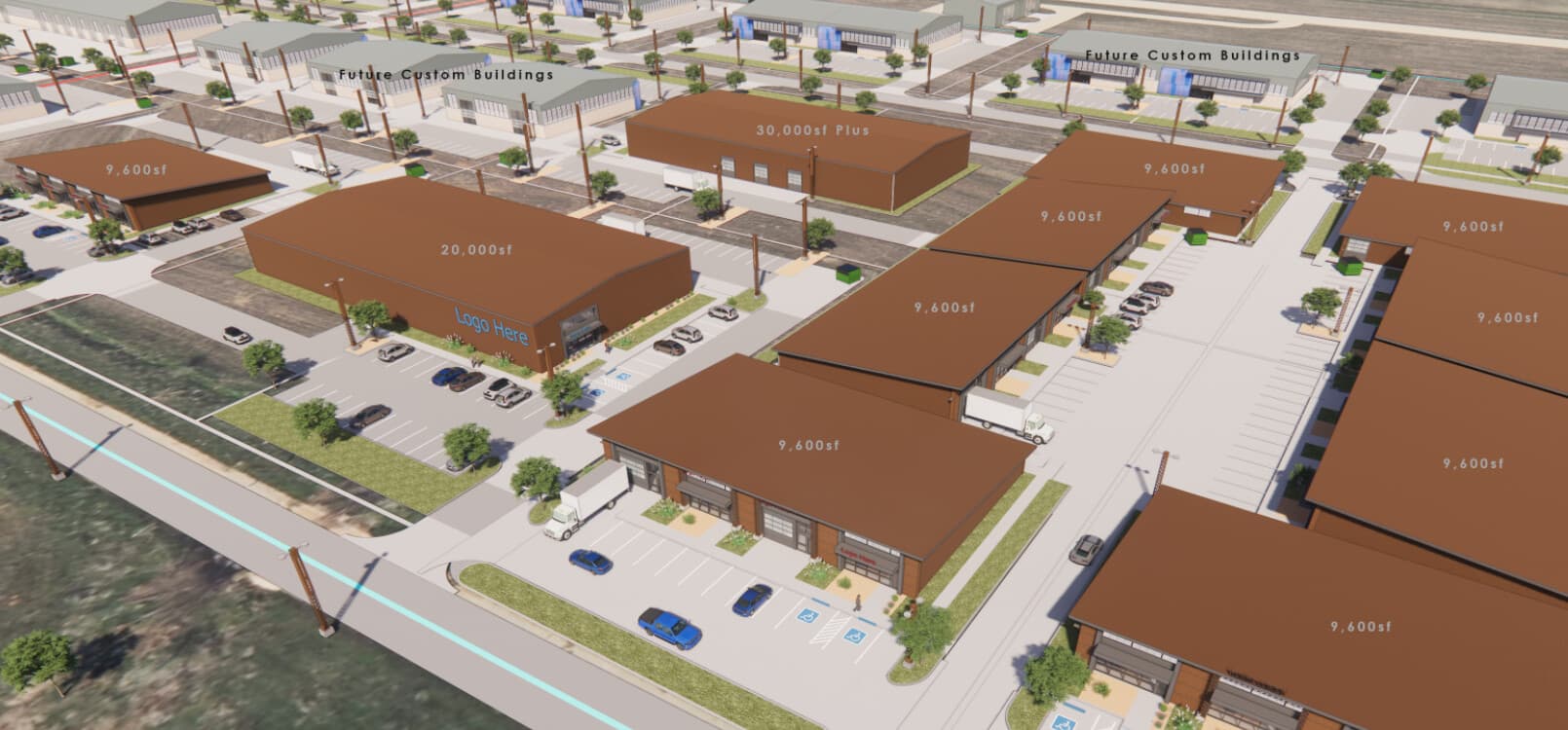
The park is laid out as repeating spec buildings rather than one monolithic facility, so a specialty shop and a large-format producer can both find a footprint without waiting on a custom build.
9,600 sf
Spec shop building
Drive-in bays, dedicated parking and truck apron. Take one unit or several adjacent.
20,000 sf
Anchor building
Single-tenant footprint at the park entrance with street presence and signage.
30,000 sf +
Large-format production
Clear-span floor for high-volume machining, forming, and assembly lines.
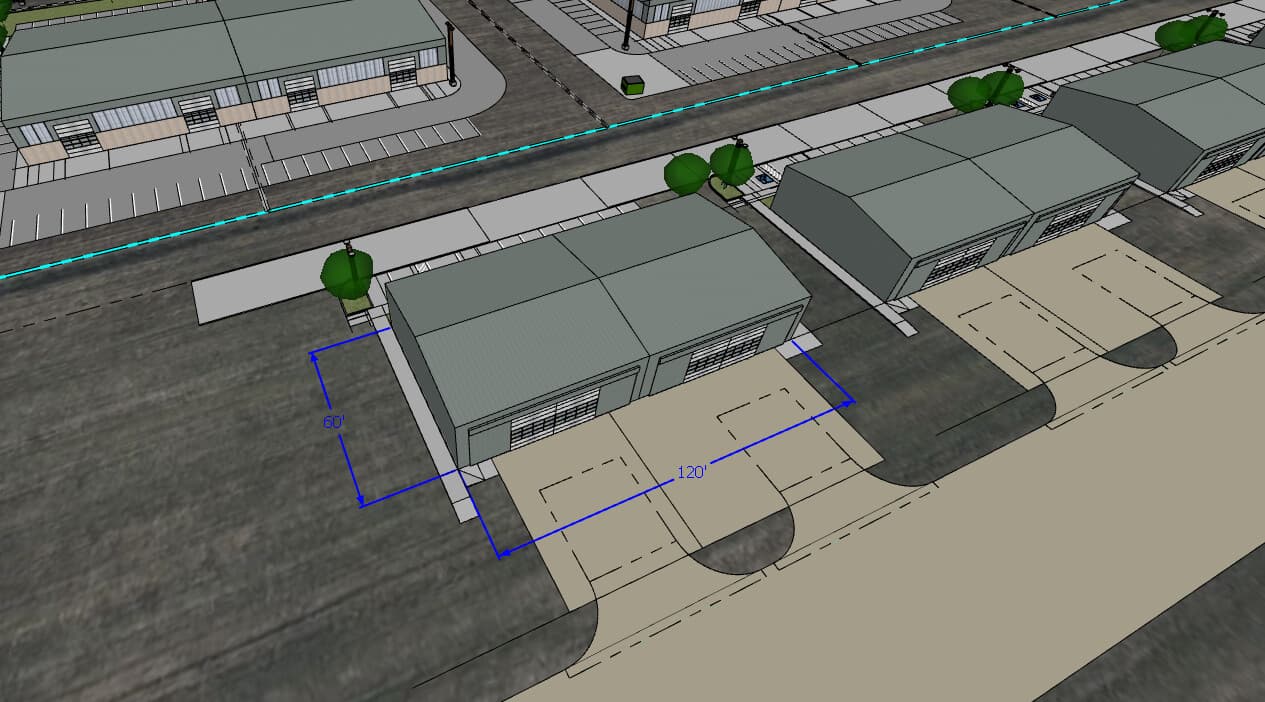
60 x 120 ft
Shop bays
Drive-in bays with roll-up doors and hardstand for machining, tooling, and finishing.
210 x 102 ft
Airport hangars
Hangar structures on the apron with direct taxiway access for large assembly.
Build to suit
Custom pads
Reserved throughout the master plan for a purpose-built facility.
Oklahoma Incentives
The State Wants This Built
Oklahoma's manufacturing incentives apply on top of the campus infrastructure. Eligibility and amounts depend on payroll, capital investment, and program qualification — we help residents work through it.
Quality Jobs Program
5% Cash Back
On new payrolls for up to 10 consecutive years
Property Tax
5-Year Exemption
Ad valorem tax exemption for qualifying manufacturers
Sales Tax
Exempt
On qualifying manufacturing equipment and machinery
Workforce Training
State-Funded
Custom training built with Oklahoma CareerTech
Workforce
The Trades Are Already Here
Grady County and the surrounding region have deep trade knowledge and a CareerTech system built for exactly this work. What has been missing is a reason for those graduates to stay in defense manufacturing locally.
Career tracks on campus
CNC Machinist
CareerTech certificate, then apprenticeship
$50K – $75K
Certified Welder (AWS)
CareerTech welding program, 960 hours
$55K – $80K
Quality / NDT Technician
NDT certification, Levels I through III
$52K – $78K
Additive Manufacturing Tech
Technical certificate plus platform training
$55K – $80K
Manufacturing Engineer
Engineering degree, OU / OSU pipeline
$68K – $100K
Typical Oklahoma ranges for these roles. Actual pay is set by resident employers.
USAO
Chickasha — on site
Primary academic partner. Workforce and education pipeline for advanced manufacturing careers.
Canadian Valley Technology Center
Chickasha — on site
CNC machining, machinist, and pipe and structural welding programs feeding the campus directly.
University of Oklahoma
Norman — 37 miles
Gallogly College of Engineering. Engineering talent for resident manufacturers.
Oklahoma State University
Stillwater — 106 miles
Materials, mechatronics, and manufacturing engineering, plus the Advanced Technology Research Center.
Oklahoma's CareerTech network puts several additional technology centers within fifty miles of the campus, including Caddo Kiowa, Mid-America, Moore Norman, Francis Tuttle, and Mid-Del.
Your Capability Is On the List
If you forge, machine, print, coat, or inspect, there are parts in the queue that have been waiting on someone who can. Tell us what you build.